304 vs 201 Stainless Steel: What Food Jar Importers Must Check Before Ordering
Two insulated food jars sit side by side in a supplier's catalog. Same finish, same capacity, same "stainless steel interior" on the spec sheet. One is priced meaningfully lower, and the difference comes down to a single line most quotes never spell out: the steel grade.
We manufacture vacuum-insulated food jars, bento boxes and kids' bottles, and we have quoted against 201-based competitors more times than we can count. This guide explains what actually separates the two grades, how each one fails in the field, and the three checks your QC team can run before a deposit leaves your account.
What 304 (18/8) actually means
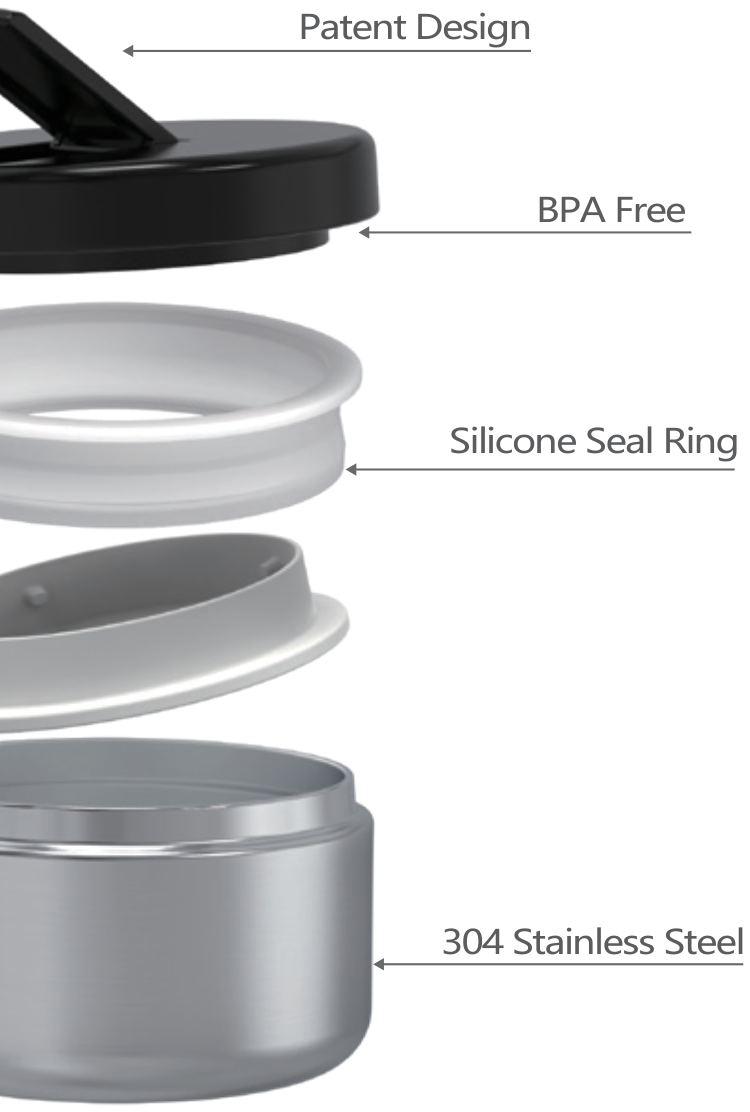
The shorthand "18/8" refers to composition: 18% chromium and 8% nickel.
Chromium is what makes steel "stainless." At sufficient concentration it forms a passive oxide layer — a self-repairing film that re-forms within hours if scratched. This is the corrosion resistance your customers experience as "the interior still looks new after two years."
Nickel stabilizes the austenitic crystal structure. In practice, that means the steel can be deep-drawn into a jar body and welded into a vacuum assembly without turning brittle. Nickel is also the most expensive alloying element in the mix — which is exactly where cheaper grades start cutting.
304 is the food-contact benchmark named directly or indirectly by the frameworks most importers work under, including FDA 21 CFR in the United States and the material expectations behind EU food-contact compliance under EC 1935/2004. When a retailer's lab tests a food jar, the steel grade is the assumption the entire test rests on.
Where 201 saves money — and where it costs you
201 lowers cost by substituting manganese and nitrogen for a large share of the nickel content. The result is a steel that looks nearly identical, polishes to a similar shine, and passes a visual inspection on the day of delivery.
The failure modes arrive later, on timelines you own:
- Weld-seam corrosion. Vacuum food jars carry several weld seams. Lower nickel content weakens corrosion resistance in the weld zone, and the first field rust almost always starts there — typically where the outer wall meets the base.
- Acid migration and metallic taste. Tomato soup, citrus segments, vinaigrette — weakly acidic food is the daily reality of a lunch jar. 201's protective film is less stable in mild acid, which shows up as metallic off-notes long before any visible rust. On a kids' food product, that is a complaint you cannot defend.
- Vacuum decay. Both grades insulate on day one; the vacuum is what fails over time. Corrosion inside the sealed wall accelerates outgassing, and a 6-hour heat curve quietly becomes far weaker in year two. The product still "works" — just not to the spec printed on your retail box.
The arithmetic nobody puts in a quote: the price advantage of 201 is realized at the factory, while the failure costs land on your P&L — returns in months 12–24, marketplace reviews mentioning rust or taste, and retailer QA escalations that put your next PO under scrutiny.
Three checks before you wire a deposit
These apply to any supplier, including us — a factory that resents being verified is telling you something.
1. Mill test certificate per production batch. Ask for the material certificate that traces your order's steel to a melt number, and check that the listed nickel content sits in the standard 304 band. A generic, undated "304 certificate" shared as one PDF across every customer is not batch traceability.
2. XRF spot-check at inspection. A handheld XRF analyzer reads alloy composition through the surface in about 30 seconds, non-destructively. Third-party inspection firms offer this as a low-cost add-on. Point it at the interior bottom and at a weld seam — the two locations where substitutions hide, and where they matter most.
3. One-time lab analysis on first order. For a first run with a new supplier, send a sample interior to an accredited lab for full composition analysis. It settles the question at the chemical level, beyond any paperwork.
A supplier quoting 304 should accept all three without friction. In our quotes, the steel grade is listed per component — body, base, liner — so this verification is easy to run against us.
Why we build every food-contact surface from 304
The honest version: 201 was always on the table. Every factory in this category has run that calculation, and the savings on a full container are real.
We build children's foodware. The interior of the jar is the one component whose failure mode reaches a child's lunch, and by the time a complaint reaches an importer, it carries the brand's name — not ours. Holding food-contact surfaces to 304 is a decision about which number we would rather optimize: the one-time saving, or never hearing about corrosion again.
That is the whole strategy. Not marketing — just choosing which problems we refuse to have.
Sourcing insulated foodware? Start here.
Tell us the lines and capacities you're pricing, and your target market — we'll reply with models, MOQ tiers and a quote.